


FibroScan® examination is a non-invasive, fast, and safe method for assessing liver fibrosis and steatosis. Take care of your health today.
Discover the benefits of choosing the non-invasive FibroScan method for liver diagnostics
The examination does not require blood sampling or tissue disruption, it is painless and safe.
The examination takes only 5-15 minutes and you get the result immediately after completion.
The examination covers a larger area of the liver than biopsy, increasing diagnostic reliability.
No pain, complications or need for hospitalization, unlike invasive biopsy.
The examination can be repeated at any intervals, allowing effective disease monitoring.
Recognized as the first-line standard in the diagnosis of chronic liver diseases by scientific societies.
FibroScan examination is quick, painless and requires no special preparation. Here is how the whole process looks like.

For 8 hours before the examination, you should refrain from eating. It is also recommended to avoid alcohol for several days before the test.
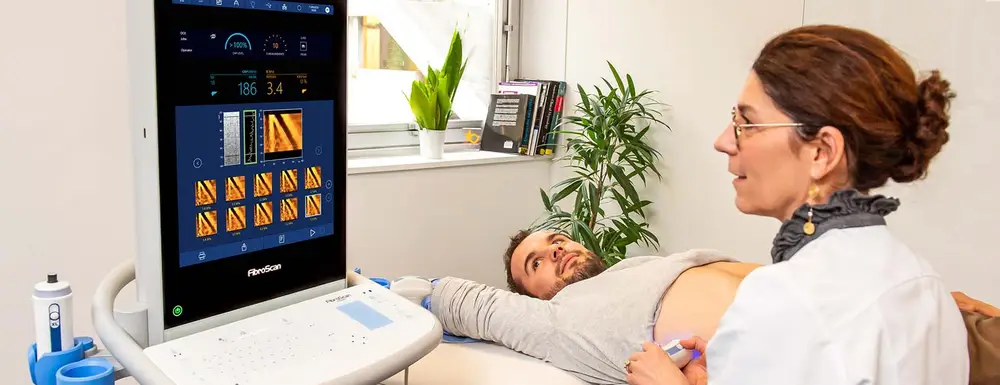
The patient lies comfortably on their back, with the right arm raised above the head, which provides the best access to the liver area.
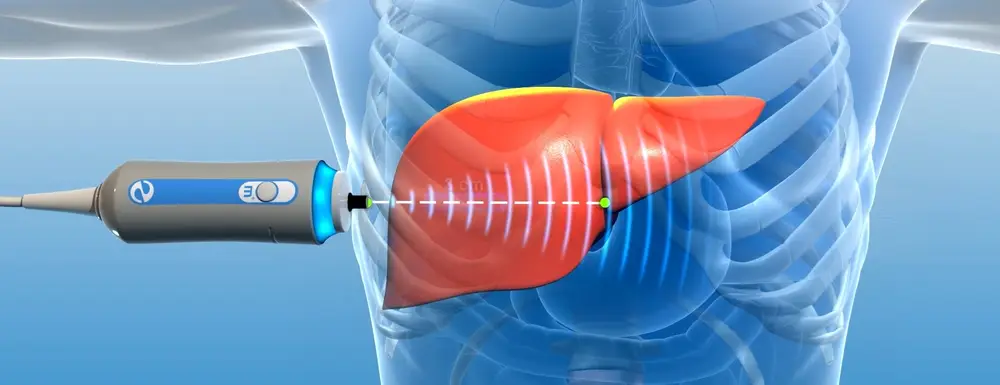
A probe emitting gentle vibrations is applied to the skin. About 10 measurements are taken to increase accuracy.

Immediately after the examination you receive the result in kilopascals (kPa), along with interpretation and recommendations from a specialist.
See how FibroScan compares to other diagnostic methods used in liver assessment
| Method | Characteristics | Advantages | Limitations | Recommendation |
|---|---|---|---|---|
| FibroScan Recommended | Transient elastography, assessment of stiffness and steatosis |
|
|
Recommended |
| Liver biopsy | Liver tissue sampling for histopathological examination |
|
|
Alternative |
| SWE elastography | Ultrasound with shear wave generation, liver stiffness assessment |
|
|
Alternative |
| MR elastography | Magnetic resonance elastography |
|
|
Alternative |
Find answers to the most common questions about FibroScan examination
FibroScan® is a modern, non-invasive diagnostic method used to assess the degree of liver fibrosis and steatosis, using transient elastography technique. The examination involves applying a special probe to the skin in the intercostal area, which generates mechanical waves. The speed of these waves propagation through the liver depends on its stiffness - the greater the fibrosis, the faster the wave propagates.
Preparation for the examination is simple: you should be fasting (at least 8 hours from the last meal), it is recommended to avoid alcohol and other stimulants for several days before the examination. It is worth bringing with you previous liver test results, if you have any.
No, FibroScan examination is completely painless. The patient may only feel slight vibrations or tapping in the place where the probe is applied, but they do not cause pain or discomfort.
FibroScan examination usually takes from 5 to 15 minutes. The result is available immediately after the examination, so the patient immediately learns the condition of their liver and can discuss it with a specialist.
FibroScan examination is recommended for people suspected of having liver diseases, such as: chronic viral hepatitis (HCV, HBV), non-alcoholic fatty liver disease (NAFLD), alcoholic liver disease, as well as for patients with liver cirrhosis to monitor their health. It is also a valuable screening test for people with risk factors for liver diseases.
FibroScan examination has few contraindications. It is not performed on pregnant women. In people with abdominal obesity, ascites or very thick subcutaneous tissue, the examination may be more difficult to perform or less reliable, but modern FibroScan devices are equipped with special probes for examining obese people.
In many cases, FibroScan examination can replace invasive liver biopsy, especially in assessing the degree of liver fibrosis and monitoring the course of the disease. However, there are situations when liver biopsy remains essential, especially when detailed histopathological assessment is needed or other liver pathologies are suspected that FibroScan will not detect.
The frequency of FibroScan examinations depends on the individual patient's situation and is determined by the doctor. In case of monitoring chronic liver diseases, the examination may be repeated every 6-12 months. The advantage of FibroScan is the possibility of frequent repetition of the examination without risk to the patient.
Contact us to schedule a FibroScan examination or get more information
+48 661 240 040
+48 577 655 977
Pon. - Pt. 9:00 - 18:00
ul. Królewiecka 161/14
54-117 Wrocław
Budynek Blue Park, II piętro
Poniedziałek - Piątek: 9:00 - 18:00
Sobota, Niedziela: Zamknięte
Your request has been received. We will contact you as soon as possible.